Pyrotenax by Chemelex · NY · Philly · DC · Virginia statewide
When a building is on fire, a handful of circuits have to keep working: the ones that run the systems people and firefighters rely on to get through the emergency. For years, the standard way to protect them was to bury ordinary cable in concrete. The codes have moved on. Has your spec?
Concrete was built for a one-hour world
According to Chemelex, encasing non-fire-rated cable in 2 inches of concrete, wrapping it in drywall or gypsum board, or running it through concrete block all date back to when codes only asked for one hour of fire protection. To meet the listed requirements today, Chemelex says concrete construction needs to be four or five inches thick.
The requirement itself has changed too. Per Chemelex, by 2017, 42 U.S. states and Canada mandated a minimum two-hour fire rating for critical circuits in buildings, meaning those circuits have to keep operating for at least two hours during a fire test.
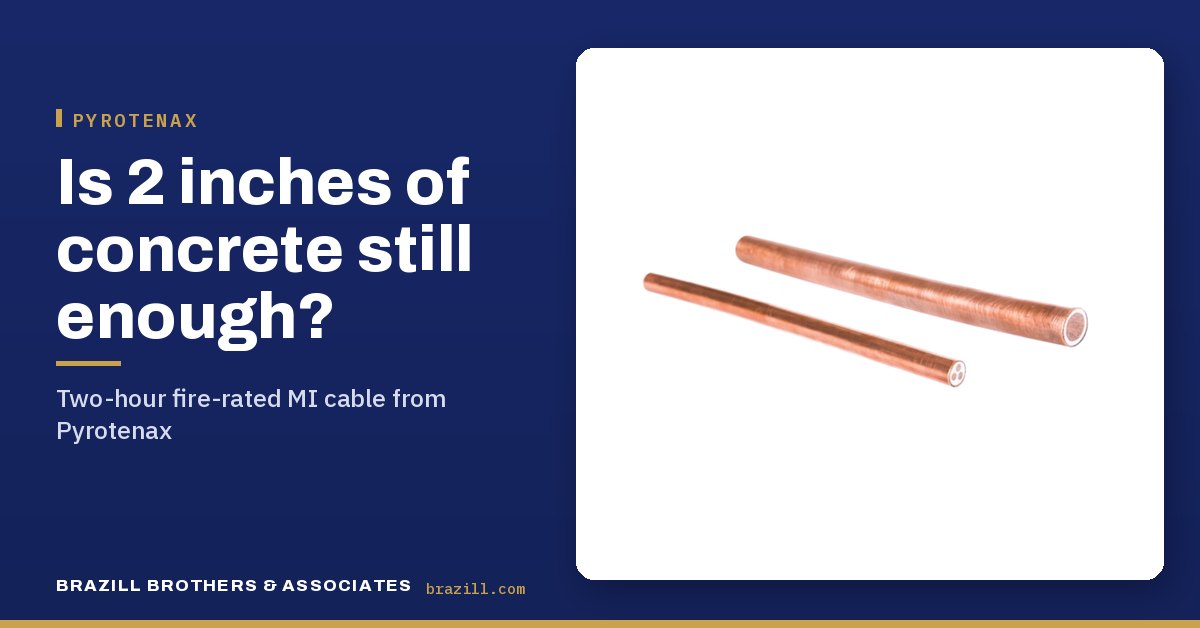
What MI cable does differently
Pyrotenax Mineral Insulated (MI) fire-rated wiring systems are built to protect people, processes and critical circuits during a fire or other emergency:
- Two-hour fire-rated cable that helps keep critical emergency systems running.
- More current in less space. Chemelex says MI cable carries a greater current and needs less space than common electrical cables.
- A system that can be tested, rather than relying on how thick someone poured the concrete.
Help for the spec and the design
- Specifications on MasterSpec, ready to download, edit and drop into your project manual.
- Quick Voltage Drop Calculator for sizing runs.
- Comparisons: fire-rated wiring vs. concrete construction, and MI vs. polymeric alternatives.
Find them on the Pyrotenax site.
Bring us your Pyrotenax project
Working through a fire pump, emergency or critical-circuit design? We’ll help with the spec, submittal and product selection across NY, Philly, DC and all of Virginia.
Code history and product claims are from Chemelex (chemelex.com/en-us/pyrotenax) as of October 2026. Always confirm requirements with the authority having jurisdiction.